The brief history of the Internet
By Gergely Sinka
1957:
The USSR launches Sputnik, the first artificial earth satellite. In response, the United States forms the Advanced Research Projects Agency (ARPA).Its function is to use the technological developments in the military.
1966:
ARPA frames the ARPANET plan. It is about physical connection between some hosts.
1969:
The first physical network is constructed by the BBN and the University of California at Los Angeles. Then the second line between the MIT and The University of Utah. These connections worked on 56Kbps speed.
1971:
Ray Tomlinson at BBN sends the first e-mail. He brings in the use of @ sign in e-mail addresses. At this time the first mail administrator program is written with the functions we all know (send, receive, forward, reply).
1979:
The e-mail emotions became commonly used.
1980’s:
The ARPA finishes putting together the Internet Protocol (IP) and the Transmission Control Protocol (TCP). Then the TCP/IP standard becomes the result.
The University of Wisconsin developed the first name server. It means that the users don’t need to know the exact location to connect to any other system. It is enough to type the name of the web site.
A connection is established from Germany to China.
The Internet Relay Chat (IRC) is developed.
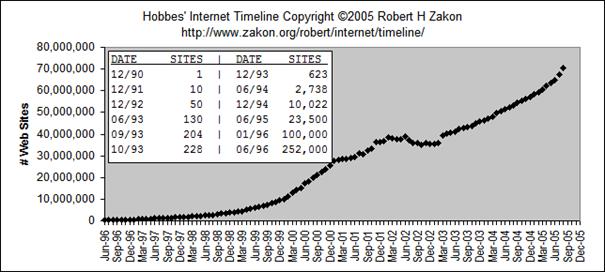
The number of hosts which contains web pages reaches the 100 thousand.
1990’s:
The online age starts.
The dial-up connection and the firs internet trade companies comes up.
Gopher the search engine appears.
The number of hosts reaches 1 million
Jean Armour Polly writes the expression: Surfing on the net.
The White House and the United Nations connects. The President of The USA’s e-mail address: [email protected]
Internet traffic grows by 340000%.
Companies realises the possibilities the internet can provide. Users are available to order pizza online and use internet banking.
Sun introduces with JAVA.
Netscape goes to the stock market and dozens of companies after.
In 1998 the size of the web is about 300 million pages.
The Mp3 revolution explodes.
2000’s:
In The middle of the interest are Napster and other peer to peer file sharing technologies.
There are more spam mails than legals.
Worms, viruses and other parasitic programs disperses. The users must be protect their computers strongly.
Nowdays illegal peer to peer and software downloads causes the biggest problems.
Since the digital photos became popular the companies changed their approach to serve this new needs.
The Google caused revolution continues and joining web pages with new services trying to gather useful information of users to use it in business.